Wednesday, June 2, 2010
Farewell to workshoppers

Species Showcase #3: continued
A massive effort was put together to build a fleet of ships that would carry them away from Basar, and out of the radius of the supernova that their sun would become. Over five hundred ships were built, dubbed Sunriders, for the solar sails that would use the massive energy discharge of the supernova chasing them to propel them faster through the wormholes they opened before them to exceed the light barrier. They would ride the shockwave of their dying sun to their new home.
The project was completed mere weeks before the predicted date of destruction, and the sun had grown noticeably in the sky. Even the night side of the world was bathed in twilight from it's glory. Every night ships launched, until the final few set off for a new world. Three days after the last refugees fled, Basar fell into it's expanding sun, the Tol raising a planetwide symphony to greet it.
The sunrider fleet struck out among the stars, fire lapping at their heels, in search of a new home.
Species Showcase #3: The Tol
As they developed sentience, towns and cities began springing up next to the swamps, lakes, and rivers. With the development of plumbing and watertight tubs, Tol civilizations were able to expand farther, though most Tol are uncomfortable in dry climates.
During their middle ages, two civilization, each backed by a powerful religion, were able to seize control of nearly the whole of Basar. The Temple of the Oracles, on one side, was obsessed with prophecies handed down by a chosen group of "Oracles", who bathed in a neurotoxin that short circuited their nervous systems, making them ill and delirious, but giving them an odd insight and instinctual understanding of patterns, allowing them to often make startlingly accurate predictions. The Contemplation of the Depths, on the other, was essentially an organization of scholars who followed around "Great mediators", wise elders whose every statement or action was taken as profound. The species was united in a renaissance and a golden age when the two religions were reconciled, becoming two halves of the same temple, and in the same bold move seizing control of the government.
At their technological and cultural height, the Prophet of the heavens, who had the now relatively unimportant role of predicting the movements of the stars and other celestial bodies, came forth with a prophecy that threw her world into turmoil. She predicted that their sun would explode in a supernova that would "devour our world, and eat our neighbors among the stars." She'd predicted the end of the world.
GM Diaries #4: An interstellar scheme
From his connection with the ship, he realizes that the aliens are being controlled by the nanobot upgrades they've been providing, their brains literally tied into the network that the AI ran on. The genie turns into Doctor who, configuring his sonic screwdriver to attack the nanobots directly, forcing them to shut down and disintegrate.
By interrogating the aliens, along with the two humans who had been doing the upgrade procedures, they found out that the aliens had been controlled by an entity called The Resonance, a sentient computer virus that had seized control of their world after "nano-upgrades" became popular. The humans revealed that the aliens had found earth and set up this whole infiltration plan after coming into contact with Kruger, the man who stole humanity's first starship. The man who sold the world.
GM Diaries #3: The Plot Unveiled
One of the heroes tracks one of the runaways down, and interrogates him. He finds out that a lot of the local gangs have recently been buying "upgrades" from a shady clinic run out of a warehouse.
When they approach the warehouse, it appears to simply be a normal, if sparsely stocked, warehouse. A little investigation, however, reveals that the boxes and crates are holograms, and as soon as someone walks into the middle of the room, they are attacked, the illusion disappearing, revealing two squads of alien shock troops with advanced weaponry and a desire to keep their secrets.
Saturday, May 29, 2010
GM Diaries #2: The Characters
There's a lot of wrangling at this point over the exact makeup of these characters powers, to make sure every character is basically what they were envisioned as and has the ability to be a badass at least once or twice a session, with no one character outshining the rest, and without them having the ability to solve every problem with a simple application of those powers. Also, each character is given weaknesses for me to exploit, to keep the obstacles I throw at them from seeming trivial.
I explain to them the background of the setting, and ensure that their characters will fit the setting and atmosphere of the game. (generally this involves making sure they at least generally care about saving people's lives and aren't completely ruthless about it.)
With all this done, I introduce the characters to their first encounter: They're all at the mall, for one reason or anther, when a gang of criminals with guns holds the place up...
Wednesday, May 26, 2010
Another new Segment: GM Diaries
I know my players are far too independent to try to lead them by the nose, so I'm using a much more "sandbox" method of plot direction, where I write what's going on in the background universe, determine who knows about it and let the players stumble across sources of information, and then find out what they plan to do next before the night's session ends so I can have a head start in my thinking next week. I try to end each session with the heroes having accomplished something, and gauging a general direction for their next actions.
Wednesday, May 19, 2010
Species Showcase #2: Nevadra
Through this network, a central, collective consciousness was born. This mind was distributed equally between all Nevadra, and directed their actions toward mutually beneficial goals. They never knew war, or politics. Suffering, want, and death were only discomforts to be eliminated with a new reorganization of efforts.
Nevadra cities were scattered across the planet like a handful of gemstones flung, new technologies making their lives comfortable and leisurely. At first, this state of affairs brought their linked mind to a new level of contentment, able finally to rest and contemplate the mysteries of the universe.
Once the contemplation began, the contentment did not last.
Very few sentient brains ever truly stop working while alive. The Nevadra brain is no exception. While they eat, while they sleep, while they daydream, the Nevadra’s minds remain active, processing the collective thoughts, ideas, and wonderings of the species as a whole. This proved an extraordinarily efficient way to process mathematics, science, and other answerable questions. It was philosophy, and the unanswerable questions it contained, that they were somewhat less adept at dealing with.
These questions, with no truly satisfactory answers, were left in the collective mind of the Nevadra, reverberating through the network of linked brains, becoming more urgent, more frantic, and more crippling with each new consideration. Before long, the mind found it difficult to focus on anything else.
Metaphysics brought the scientific minds in the Nevadra’s network to their knees, certain that it must solve the problem of how the universe really works, beyond all observable evidence, before it could put it’s minds to anything else. Each new model, each new concept, only raised more questions, and each was based on such flimsy evidence as to collapse entirely under the scrutiny that could not help but be leveled against it.
The question of morality was worse. Before they had developed painkillers and sedatives, they had adopted the practice of killing badly injured or sick Nevadra to spare themselves from their pain. Its defense against this guilt, that the mind as it existed now was not the same mind as then, only further complicated the issue. None of the Nevadra who had played host to the mind of the past sill lived, leaving the collective mind to wonder if it really was the same at all from one moment to the next.
But all these problems were manageable compared to those caused by the biggest question of all: whether it’s existence had a purpose.
Every purpose the shared mind tried to attribute to itself seemed wholly inadequate, either ancillary to some further purpose, or boiling down to a seemingly pointless concept, like survival or experience. As it began to wonder if it’s existence had any meaning at all, it had lapses of malaise and self destruction, segments of the population falling into a depression, barely meeting their own needs, while others participated in violent outbursts, as if the Nevadra hoped to learn the meaning of life by studying pain and death.
The collective consciousness slowly came to realize that this painful and doubting existence was intolerable. It had become aware, in the early days of it’s technological revolution, of the effects of radio waves on a Nevadra’s connection to the collective consciousness. The right radio frequencies would cause interference, and in one experiment, even complete isolation for a short time, with apparently no significant lingering affects once the Nevadra in question rejoined the group mind. It was clear that more research was necessary; to both distract the mind from its unanswerable questions, and to finally put an end to them.
In a year’s time, the inhibitor was designed and built. A device capable of generating the complex signal necessary to blot out each Nevadra’s connection with the rest of the species, using the planet’s native magnetic field to carry that signal to every point on the globe. When the inhibitor was activated, the collective consciousness would end, replaced by meaningless static. After that, only individual minds would remain, too small, to self absorbed, to be trapped by the unanswerable questions.
Was this suicide? Did the group mind exist apart from those creatures that served as its hosts and component parts? Was this the right thing to do?
With the pull of a lever and the press of a button, those terrible questions vanished.
Friday, May 7, 2010
Sci-Fi Concepts continued: Technology
Newly imagined technologies have been an important aspect of science fiction more or less since it's beginnings. When Mary Shelly wrote Frankenstein, she conceived of a device capable of reanimating dead flesh, and imagined the aftermath of it's use. When writing 1984, George Orwell imagined a television screen with a camera built into it, as a part of a society without privacy. In Star Trek, Captain Kirk beamed down to planets using a teleporter, a device able to turn a person into an energy pattern, transmit them at the speed of light to a location, and then re-solidify them, because the show did not include the budget to film a shuttle ride to the surface of a planet.
When writing new technologies into a setting, it is important to maintain a sense of consistently, and to keep track of the scientific laws which you have allowed your characters to break. Here's a primer on a few technological concepts that you might think to include.
Gravity Control: sometimes called inertics, a technology that allows the control of gravity has many implications. The use of artificial gravity on starships and space stations is one common aspect of gravity control. Inertial compensators, which allow pilots to survive incredibly high speed turns, are important for light starships and "space fighters", which require a great deal of maneuverability to have a chance to survive. Gravity could also be used as a form of propulsion, making an object "fall" in the direction you pilot it. Gravity control technology can also be weaponized, allowing it to be used to immobilize or crush people, or to tear structures apart.
Monday, May 3, 2010
Scifi Concepts continued: Hardness
"Hard" science fiction is science fiction that assumes few, or even no, significant paradigm shifts in technology. A setting becomes softer with the existence of Faster than Light (FTL) travel or communication, teleportation, energy weapons, and other dramatic advances in technological capability that cannot be explained with current science.
"Hardness" and "softness" are measured on a sliding scale, with a setting becoming "softer" as it includes more extreme technologies. To assume that we will be able to build an engine that is capable of significantly higher speeds than is currently possible does not significantly soften a setting, but to assume we will be able to break the light barrier, or manipulate gravity, is. The presence of extraterrestrial life, fairly common anomalies which bend the laws of physics, and other setting detains for which there is currently no evidence, also make a setting softer.
A setting with no artificial gravity, where the earth has colonies on the moon and Mars, and engages in endeavors to mine the asteroid belt, would be a relatively hard science fiction setting. Comparatively, a setting focused on the movements of a spaceship across the galaxy as it solves moral and political dilemmas arising from interactions with alien societies would be a soft science fiction setting.
It is important to remember that these terms are not pejorative. Hard science fiction is not better than soft science fiction, only different. A reader who believes that the setting he is reading about is "hard" will likely be dismayed if "soft" elements make an appearance without significant explanation and purpose.
A few science fiction concepts
When writing science fiction, you are effectively conceiving a new world. Much like in fantasy, it is important that the rules of this world are consistent with themselves, even if they have little relation to the world we live in. Even a setting as seemingly obtuse as the one presented in The Hitchhiker's Guide to the Galaxy (by Douglas Adams) comes to an understanding with the reader about what sorts of things they can expect. To significantly shift paradigms after establishing a consistent setting is a risky maneuver, and may leave readers feeling betrayed. Most of these concepts involve the categories that a reader will place your setting into in order to determine what they can expect.
Scope:
How big is your effective setting? one country, one planet, one solar system, a cluster of stars, an arm of a galaxy, a whole galaxy, or even several galaxies are all possibilities. The scope of your setting will be tied significantly to the maximum distances and speeds that people can expect to be able to travel. If no faster than light method of travel is possible, then your setting will likely be relegated to just a few colonies, or even just a single solar system.
The scope of a setting tells readers what reasonably is at stake, and how complex and diverse your world is. If the furthest anyone is able to go is out to the asteroid belt, they will have a different set of options than if they were in a setting in which they could reach the next galaxy. If there are thousands of inhabited worlds, with billions of people on each of them, then the crush of it's vastness should seem overwhelming, especially if they all are in communication and travel range of each other.
Thursday, April 29, 2010
Kydians continued
Once the most basic technological concepts were discovered, innovation and re-engineering became a staple of Kydian cultures. The Atlatl, the bow, the screw pump, the crossbow, the telescope, the lightning rod, and the first flying machine were all developed within a thousand years of each other. When the mathematics of scientific research evolved far enough to place it out of reach for the common Kydian, this trend became less prevalent, though tinkering with mechanics remains a popular pastime.
Wars between the various empires, kingdoms, and nations of the planet Kydia were cyclical, each faction hoping that the new technological advantages they had achieved would give them an edge, allowing them to conquer their neighbors. This cycle of war, peace, and rebellion continued for centuries into the modern era, until the horrors of modern warfare, the parallel development of several cataclysmic weapons, and the integration of all nations in a global communications network wore down the Kydian people's willingness to wage war.However, it wasn't until their first contact with a hostile alien species that the various Kydian states reformed themselves into a single republic.
Saturday, April 24, 2010
Species showcase #1: Kydians
Kydians are short, thin creatures with physiques optimized for climbing, swinging, and leaping through their native forest environment. Their lightweight frame, powerful arms, handlike feet, and prehensile tail allow them to soar through their native forests, chasing the insects that compose the majority of Kydian diets. Their long, swept back ears can pull and rotate, allowing them to find the origin of a sound and amplify it. The antennae concealed in these long ears transmit and receive radio waves, allowing instant and soundless communication regarding sources of danger and coordination of movements among a pack.
Like all life on the planet Kydia, Kydians are hermaphroditic, each Kydian both giving and receiving reproductive fluids during intercourse, and both participants (or in some cases, all participants) becoming pregnant. coupling is the typical rule, but some cultures have and still do mate in larger groups.In nearly all cultures, family bonds are respected significantly.
In Kydian culture post interstellar travel, communication is as much verbal as antennae based. Technical information more easily passed using verbal communication, while emotional awareness, deep connections, and stirring personal appeals are much clearer and seem more sincere when transmitted.
Continued later.
Thursday, April 22, 2010
A new segment called...
Basically, twice a week more or less I'll write up in brilliant detail a description of the appearance, physiology, society, culture, evolution, and so on regarding an alien species I have concocted.
This is work I need to do regardless, to look back on my old inspirations and rework them, cataloging and solidifying the one's I plan to use.
Tomorrow I will begin with the species I've created the most detail on so far: The Kydians. I hope to achieve a similar level of detail with each preceeding post.
Thursday, April 15, 2010
More Webcomics

Order of the Stick
A mostly humorous comic featuring the characters in a tabletop role playing game.

Goblins
Another tabletop roleplaying webcomic which parodies and subverts many conventions of the genre, and honestly does pretty well at examining what the games are all about.

Thursday, April 8, 2010
The last two blog posts I kept more or less meaningless because I was still getting a feel for how open I was willing to be about things to you guys.
You see, throughout my college career I've realized that several of my interests are not exactly... popular in a college setting.
First of all, as you're all aware, I am a science fiction writer. As such, I am aware of the "Sci-fi Ghetto" that such works tend to fall into in the minds of many educated people. Science fiction is considered "genre" and "formulaic", and are not often considered among "serious literature," but relegated to "petty entertainment."
I don't accept this concept of what I write, and certainly won't give up science fiction because some people have a problem with it. At the same time, this perception has made me self-conscious. I have become defensive about science fiction, but paranoid about other interests that might mark me in the minds of my professors and fellow students as a childish person who doesn't take what I do seriously enough.
I am a tabletop role-player. I used to play "Dungeons & Dragons," but between the changes made to the game, and in my own growth as a gamer, I've somewhat left it behind. I've since gotten more involved with Legend of the Five Rings, a roleplaying game set in a fantastic amalgam of anchient china and feudal japan, and Shadowrun, a cyberpunk fantasy set in 2070 with megacorporations, shamans, mafias, trolls, cyborgs, and dragons. (related to but much better than the video game by the same name.)
I'm not going to hide or lie about spending a significant portion of my time and effort coming up with pasts, motivations, strategies, and personalities for imaginary samurai, mercenaries, and other assorted overblown character types. To a degree this is simple entertainment, but in it's most primal form, it's storytelling, and I enjoy it for the same reason I enjoy writing.
Some people might think less of me for my hobbies, but if they do, it's their loss.
Wednesday, April 7, 2010
Webcomics
Dominic Deegan: Seer for hireAn epic fantasy story with an incredibly detailed and unique world, powerful character development, and an ability to keep a lighthearted feel through the dark and dramatic moments.
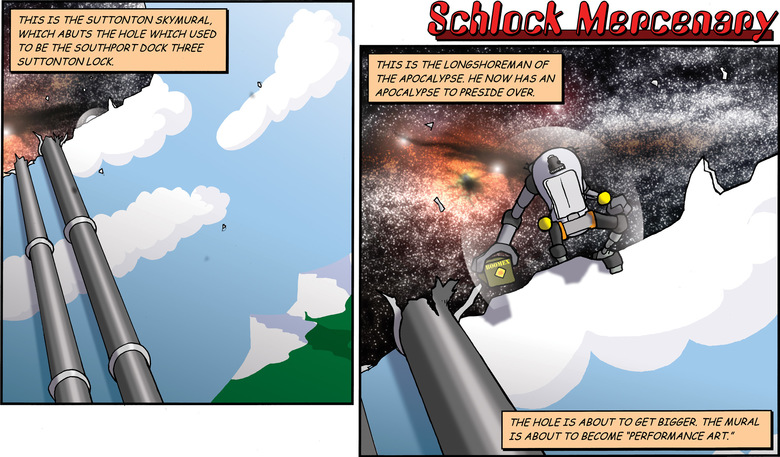
 Schlock Mercenary
A series of science fiction stories involving a group of space mercenaries as they go about screwing up galactic politics and having to deal with the consequences.
Pictures for Sad Children
Distilled cynicism that still manages to be incredibly funny.

Thursday, April 1, 2010
Some things I'm interested in
The Nostalgia Critic He remembers it so you don't have to! He examines old, bad movies, tears them apart, and often suggests how they could have been improved.
I'm a Marvel, and I'm a D.C. A hilarious video series based on the movements of the comic industry.